Warning: includes some light spoilers for both Peter Heller’s novel and Ridley Scott’s film adaptation!

At this point, the post-apocalyptic world is fairly well-trodden cinematic territory. We’ve watched world after fictional world collapse by way of viral pandemic and every kind of zombie apocalypse; we’ve seen various post-apocalyptic wastelands courtesy of nuclear war, climate catastrophe, alien invasion, artificial intelligence, mysterious fungi, and just about every other calamity human beings have managed to imagine (or perhaps predict) for ourselves. Naturally, it follows that there are only so many cracked and abandoned highways, eerily empty grocery stores and looted pharmacies with flickering fluorescent lights, overgrown metropolises reclaimed by nature, and ominous bands of machete-armed survivors one can encounter before the end of the world begins to feel overly familiar.
So, while Ridley Scott’s The Dog Stars (2026) based on Peter Heller’s 2012 novel does not necessarily offer the freshest or most exciting version of humanity after catastrophe, it does offer a lovely message about humanity, loneliness, endurance, and community that is rewarding in its own right. The key here, I think, is to not go in expecting an action-packed thriller. Although there is some action and suspense throughout the film, if you have read the book you kind of know what you are getting. Ultimately, the apocalypse of it all is far less interesting than the people trying to remain human and find meaningful connection and peace inside of it.
That’s essentially the tension at the heart of Heller’s 2012 novel, too: the constant push and pull between compassion and human connection on the one hand, and ruthless self-preservation on the other.
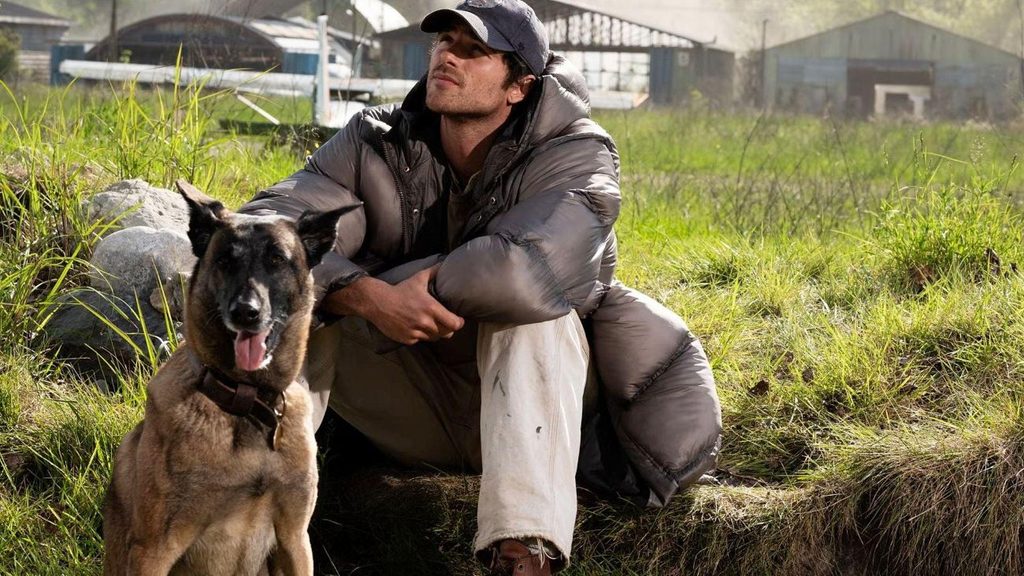
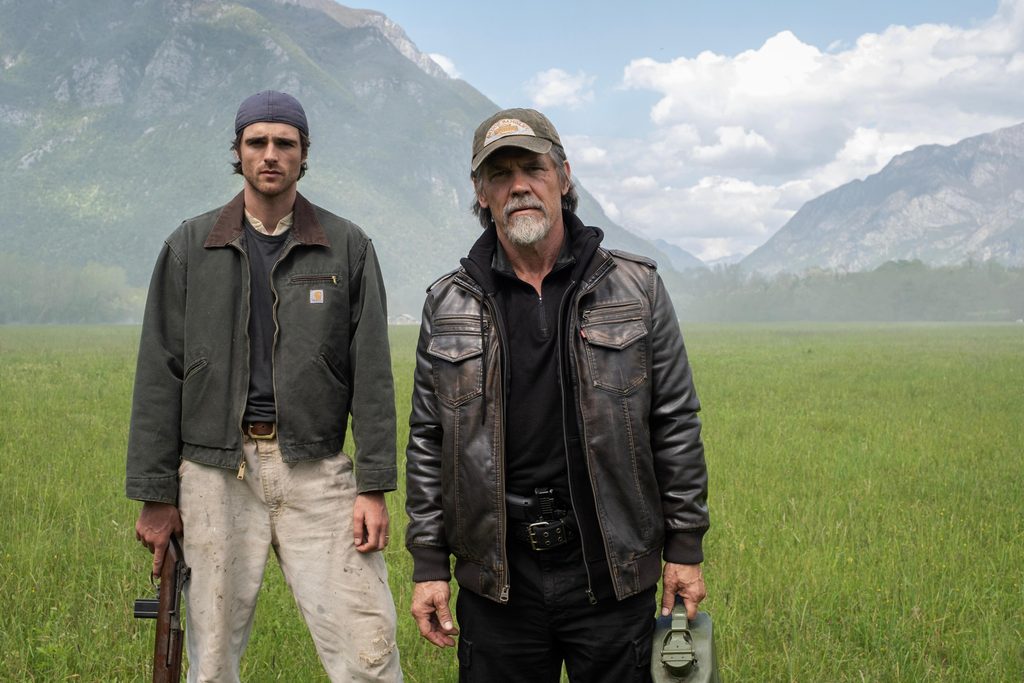
The film centers on the novel’s stream-of-consciousness narrator, Hig, who is a pilot living at an abandoned Colorado airstrip years after a global flu pandemic has decimated the modern world as we knew it circa 2012. Our hero is portrayed with a quiet vulnerability by the reliably tall and brooding Jacob Elordi, who shares this lonely existence with Bangley, played by Josh Brolin, a gritty survivalist who was basically born ready for this moment. While Hig spends his days on aerial patrol and aiding those left behind, he grapples with the internal struggle of maintaining his humanity in a new world that demands no mercy or hesitation, especially when it comes to roving pockets of armed nomads whose intentions cannot be known.
When a mysterious radio signal crackles through the silence, Hig sees, or rather hears, a flicker of hope that civilized life might still exist outside the carefully guarded borders of the Erie, CO airfield he calls home base. Urgent, unsatiable curiosity, compounded by grief and loss, launches Hig’s search for something more than the rugged, lonely life of survival and subsistence that he had long known with only the companionship of his beloved dog, Jasper, and his human survival partner, Bangley.
With this film, Ridley Scott seems less interested in creating a relentlessly high-octane, high-stakes survival thriller, than in lingering inside a strange, quiet world in the process of being reclaimed by nature and baser human instinct. It’s one of those adaptations where I actually don’t think a definitive declaration of whether the book or the movie was “better” would be particularly useful. There were certain things I liked more in the meandering, lyrical prose of the book, and certain things that I felt translated better onscreen. The film organizes and streamlines the story into something more conventionally cinematic, and while one could argue that, because of that, the story inevitably loses some of the intimacy and strangeness of Hig’s internal voice, it ultimately offers a cleaner narrative trajectory. (Believe it or not, I’m not always a book purist when it comes to adaptations; sometimes what works beautifully on the page simply needs to be translated rather than photocopied. These are two very different mediums, after all, and book-to-film adaptations are “adaptations” for a reason!)
One change I actually preferred onscreen was the treatment of Hig and Cima’s relationship. Ridley Scott’s cinematic version softens the edges of the romance. Although Elordi and Qualley definitely have chemistry on screen, I liked that the intimacy between Hig and Cima in the movie feels less about sexual desperation and more about the astonishing experience of discovering another person with whom life might actually continue after all else feels totally lost. Although I think the book digs a lot deeper into the grief and loneliness of Cima and Hig (both of whom lost spouses due to their world’s pandemic), I actually appreciated the fact that the film’s version of this romance felt more sweet, innocent, and tender; I especially loved the titular scene at the conclusion of the film in which they sit under the stars and Hig points out the constellations as he imagines them to be.
Overall, I thought the casting was spot-on (other than maybe Italy as a stand-in for Colorado). Jacob Elordi brings a quiet internalized sadness and gentleness to Hig, and Margaret Qualley gives Cima the right mixture of toughness and warmth. Bangley, meanwhile, was probably my favorite character in the novel, and Josh Brolin felt almost uncannily suited to portray him, which he does excellently. Brolin’s Bangley is gruff, hyper-competent, suspicious, dryly funny, and just barely concealing the fact that, beneath the tough exterior, he actually does care.
The contrast of Hig and Bangley plays just as well onscreen as it does in the book: Bangley believes survival requires assuming the worst of people, while Hig reluctantly survives while continuing, sometimes irrationally, to search for the best in them. Neither philosophy is entirely sufficient on its own, and, as Bangley would certainly point out, Hig probably would not have survived as long as he has without Bangley. Bangley, meanwhile, knows how to stay alive better than anyone, but he can’t do it alone. Their partnership becomes its own peculiar little civilization.
This is what The Dog Stars does best of all, why we liked it so much, and what stayed with us after the film’s conclusion. Ridley Scott’s Dog Stars doesn’t reinvent the apocalypse so much as ask what can remain once most of the scaffolding of ordinary life has been stripped away. Staying alive in a world like Hig, Cima, Bangley, and Pops’ requires constant vigilance, stern practicality, and sometimes dispassionate brutality, but remaining truly “human” and staying open to love, friendship, and community in such a world requires something else entirely: companionship, trust, tenderness, and the willingness to keep caring about other people even when it’s a liability. In the end, The Dog Stars is a lovely film that beautifully depicts people – survivors – choosing to live alongside one another peacefully, depending on and trusting one another and making life a little more mutually bearable by creating community, as opposed to the other options shown, such as toughing it out and going it alone, or simply devolving and turning to animalistic violence, control, and depravity.