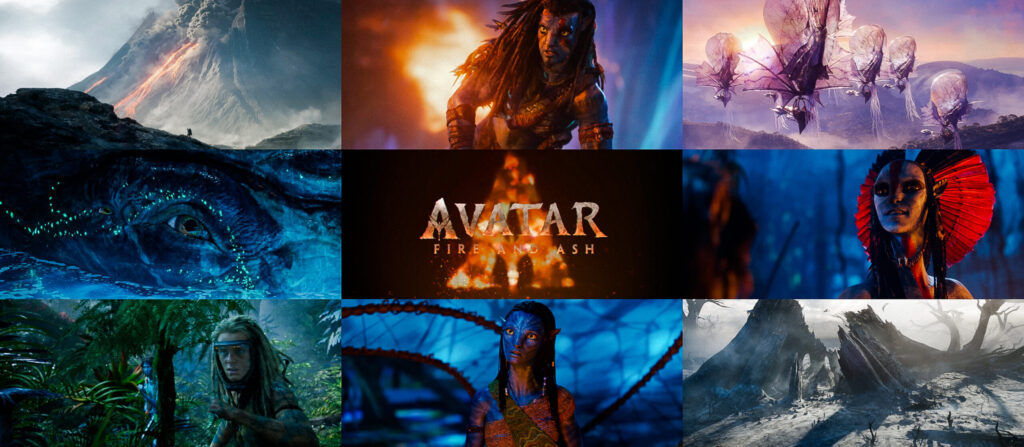
The third installment of James Cameron’s multi-billion-dollar franchise Avatar might just be our favorite yet. What a blessing it was to spend over three more hours on the mystical, otherworldly planet of Pandora, now more sprawling and culturally diverse than we’ve ever seen it before. Avatar: Fire and Ash is visually stunning, self-aware, heartfelt, and surprisingly funny, with the signature big-budget world-building we’ve come to expect from the series.
Despite its flaws, Avatar: Fire and Ash is an unmatched cinematic experience that demands to be seen on the biggest screen that you can find. While we could be like the naysayers and hyper-critical armchair critics and focus on some of the film’s drawbacks, like a few cringeworthy bits of dialogue and some choppy plot points, the cinematic visual elements of an imagined world that comes to life on the big screen make these offenses easily forgivable.
Director James Cameron and everyone involved in the project fully maximize the Avatar lore, taking you to new locales where we are introduced to new tribes and traditions, as well as revisiting locations from the first two films that have become familiar, like Neytiri’s bioluminescent jungle home, and the Metkayina’s shimmering turquoise cove.
Avatar 3 continues the series’ deep dive into themes of family, loyalty, spirituality and fearless leadership, anchored by the strong central patriarch of Earth-born Jake Sully and bolstered by the strength and shrewdness of his fierce, ferocious warrior queen, Neytiri, a native Na’vi of the Omatikaya clan. Anyone who is or has been married knows how essential it is to have each other’s backs, no matter what the world throws at you, and Jake and Neytiri embody that ideal. Neytiri’s loyalty and Jake’s devotion to their family are compelling to watch.
Across the series, Neytiri has embarked on an arc of significant character growth. At the start of the franchise, the future Mrs. Sully was deeply prejudiced against all humans. Her hostility, naturally, stemmed from the rampant destruction of her home forest, planet, and people by these pink-skinned aliens who had come to exploit Pandora’s natural resources. Throughout the second film (Avatar: The Way of Water) and much of the third, she openly spurns the human boy and honorary Sully, Spider, in spite of the boy being reared among her children as essentially one of her own, and she displays animosity for all things “pink-skin”, in spite of marrying one and birthing half-human children “freaks” (weird, grabby, extra-digital hands and all) herself. By the time Fire and Ash reaches its emotional conclusion, though, Neytiri appears to begin embracing Spider as one of her own children, finally learning to “see” the best of humanity reflected in the actions of her husband Jake, Spider, and the children (adopted and biological alike) whom they share.
The Spiritual undertones add unexpected depth to this cinematic spectacle, particularly through Kiri’s storyline, which mirrors biblical archetypes like the divine creation and birth of Christ. Like many people of faith, Kiri’s belief is repeatedly tested as she struggles to understand her place in Pandora’s cosmic order and unravel the intent behind the gift of her seemingly transcendent abilities, which appear to flow from the Great Mother, Eywa, Pandora’s reigning deity and interconnected life-force.
Eywa, the All-Mother and all-encompassing balancing force of the Avatar universe, seems to “fold her ears” to Kiri, never allowing her to “tap in” to the ancestral network to observe the secrets of the universe, instead leaving her to learn on her own. Her journey resembles classic faith narratives like that of Christ in that she must trust that guidance will come not through answers, but through action, sacrifice, and timing.
We were most pleasantly surprised with the use of the character Miles “Spider” Socorro in Fire and Ash. Portrayed with boyish charm by actor Jack Champion, the adopted Sully brother is a rare human in human-form out of place and time in the world of Pandora. In The Way of Water, Spider felt kind of like an afterthought to the story, who did little to push the narrative forward other than serving as a convenient plot device (in that he gets kidnapped for seemingly the entire movie, thus necessiating a rescue op).
In Fire and Ash, Spider is elevated to the emotional throughput and coalition builder between the Na’vi and the humans. An adopter of the Na’vi way of life who fully assimilates into their customs and religion, he represents the best of both worlds, in spite of becoming something of a liability. He’s also a seemingly selfless human who appears willing to die for his adopted tribe. [SPOILER ALERT] In one of the most beautiful and poignant moments in the trilogy, Spider woefully accepts his fate at the hands of his beloved father figure and hero, Jake, for the good of Pandora and the Na’vi. Fire and Ash sees Spider grow into a character who is heroic and easy to root for, and his blossoming romance with Kiri was sweet, pure, and honestly more palatable than you’d think given the discrepancy in size and species (though viewers are forced to confront the awkward physical implications of a potential interspcies romance in a brief but unsettling romantic scene).
With all of that said, the standout performances belong to the antagonists, particular with Varang (Oona Chaplin), the fiery and formidable leader of the ash-dwelling, volcano-adjacent Mankwan clan that gives this movie its moniker, and the familiar and reliably evil Colonel Miles Quaritch. In what is truly a feat of voice-acting and motion capture performance, Oona Chaplin steals every scene that she is in with ruthless intensity, and Varang emerges as the franchise’s most compelling villain yet.
The sociopathic and bloodlust-driven Varang’s sexually-charged dynamic with Quaritch breathes new life and — ahem — fire into his character, lending him his best arc yet. The two together also provided a surprising amount of comic relief onscreen; the trippy tent ritual scene had our theater hollering and, for us, was probably the most memorable scene of the film (to the editors who considered cutting that scene … we have our eyes on you! 👀). Quaritch’s paternal affection for Spider, plus his newfound embrace of Na’vi culture brought forth primarily by the seduction of Varang and their shared lust for power and vengeance, furnish his character with some much needed depth to round out the third and final installment of this trilogy. We SO hope we see them both again! (Which seems likely given that we didn’t actually see either one of them physically die onscreen, and another installment of Cameron’s beloved Avatar film franchise is already slated for 2029)
Avatar: Fire & Ash stands as an as-yet unmatched modern-day cinematic marvel, and a masterclass in epic sci-fi world-building, with its immersive world of neon-glowing flora, fantastical fauna, and operatic, multi-generational spectacle. Experiences like this are increasingly rare in contemporary cinema, and the Avatar franchise remains uniquely capable of pulling audiences entirely out of the real world and into Pandora’s bioluminous blue embrace; so it’s no mystery, really, why these movies continue raking in such big bucks. We may not get many more theater-going experiences in our lifetime that live up to Avatar. It’s a pleasure to have been able to live in this world for three films; the imaginativeness and grandeur of what Cameron has created has a way of immediately immersing viewers into this soaring, themepark-worthy cinematic universe, where Earth fades away and we escape into the strange and magical world of Pandora.
This walking cash cow of a movie, grossing $2 billion per entry with ease, is just a damn good time and we won’t apologize for having a ton of fun with it. To the scowly-faced critics who insist on dissecting every line of dialogue as though it’s a tense, slow-burning, Oscar bait melodrama, we say, simply: Boooooooo. We give Avatar: Fire and Ash a score of 8.8.
We’ll be among the first back on line for tickets when the fourth iteration hits theaters in 2029, but for now, take a bow, James Cameron, for a magnificently crafted trilogy that left little to be desired, and much to look forward to.